
|
CODITO SUNDAY
3 minutes to stay a week ahead
Sunday, 10 May 2026
|

Pierre
Managing Director of Codito Ergo Sum
|
|
Hello everyone,
Grab your coffee and settle in: three minutes to stay a week ahead.
This week, the balance of power in AI flipped abruptly. Anthropic has overtaken OpenAI on the ground that truly matters — recurring revenue from businesses. And that same week, both labs moved into AI consulting, to the tune of $11.5 billion combined. Before reacting to this acceleration, you first need to have laid your own foundations. Here is what's at stake, and what comes next.
|
|
|
|
|

|
Anthropic overtakes OpenAI: the balance of power has shifted
The fact: This week, Anthropic announced annualized revenue of $30 billion, surpassing OpenAI ($24 billion) for the first time. In its wake, the company reached a $1.2 trillion valuation on secondary markets on 7 May. Five days earlier, Google had committed up to an additional $40 billion to the company.
The Codito analysis: This shift was not driven by the general public. It came from businesses. Anthropic has embedded its tools — Claude, its connectors, its agents — more deeply into professional workflows than ChatGPT, which remains first and foremost a consumer product. In practical terms, in IT departments and operational teams alike, it is increasingly Claude that is taking hold, not ChatGPT. This is no longer a rumor: it is now an accounting fact.
What it means for you: If your company chose OpenAI twelve months ago because it was the obvious choice, that choice deserves to be reassessed. Not every month — but once a quarter, yes. The strategic layer your workflows rest on today will not necessarily be the dominant one tomorrow.
|
The number of the week
$11.5 billion. That is what OpenAI ($10bn via The Deployment Company) and Anthropic ($1.5bn via a joint venture with Blackstone, Goldman Sachs and Apollo) poured in on 5 May — the very same day — to launch their own AI consulting firms. AI consulting is becoming a direct competitive front for the labs, which are no longer content with just selling the API.
|
|
|
|
|
|

|
Before AI, your processes. The prerequisite no one will sell you.
When artificial intelligence comes up, the reflex is to look for the tool. Which model? Which platform? Which implementation partner?
That is putting the cart before the horse.
AI, whoever builds it, only works sustainably on one condition: it rests on structured data and processes. Yet the majority of companies — including established, profitable, well-run organizations — have neither a written map of their business processes nor an up-to-date repository of their strategic data. The rules live in employees' heads; the data is scattered across ten tools; institutional memory evaporates with every departure.
Until that foundation is in place, deploying AI on top of it amounts to amplifying the chaos rather than organizing it. Garbage in, garbage out — the 1960s adage still holds true. Your workflows rest on tacit assumptions; an AI agent, for its part, demands the explicit.
In concrete terms, documenting means three things:
- Business processes: who does what, in what order, under which rules. The exceptions as well as the standard cases. Not a general slide, but an operational document.
- Data: where it lives, in what format, at what level of quality, under whose responsibility. With a schema — not a hunch.
- Structural decisions: why you do things this way rather than another. This is institutional memory — the kind an AI agent can absorb and give back, provided it is written down somewhere.
This exercise is not glamorous. No model vendor, no consulting firm armed with billions will spontaneously sell it to you, because it does not generate recurring revenue. Yet it is what separates the companies that genuinely transform their productivity with AI from those that stack up tools without ever exploiting them.
At Codito, it is the systematic first step of every engagement. Before layering on AI, we light up the terrain. That is precisely the purpose of our AI Audit — four weeks to map your processes, identify your blind spots and formalize an executable roadmap.
Learn more about the Codito AI Audit
|
|
|
|
|
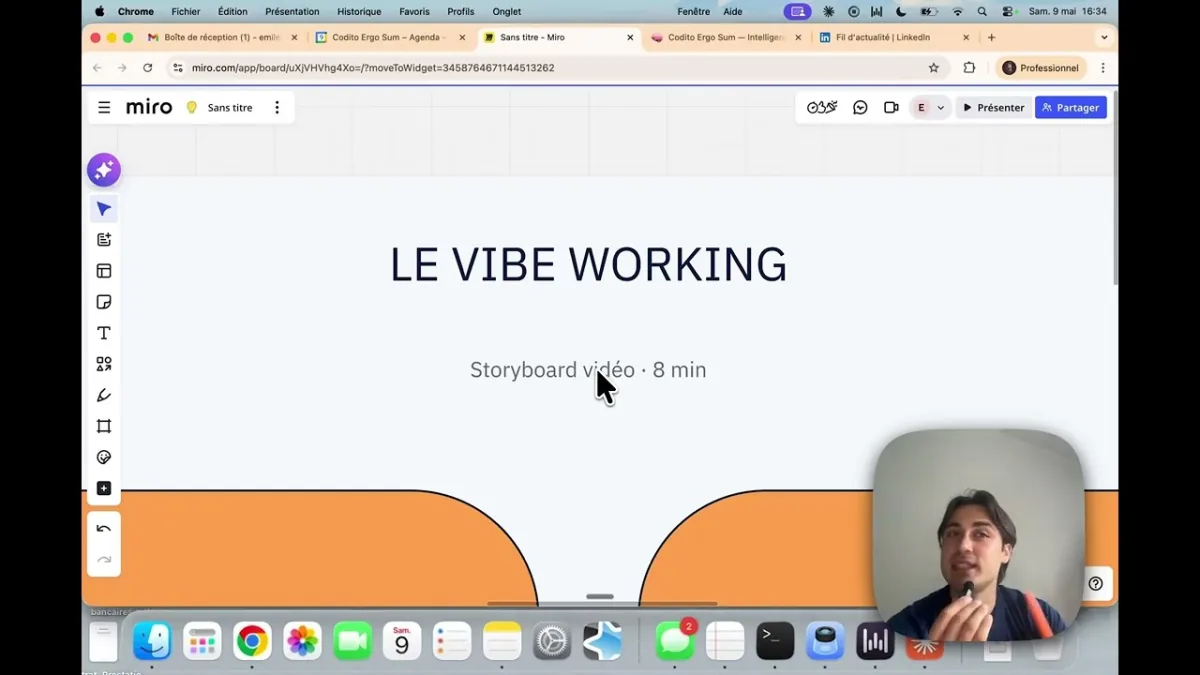
Émile decodes “vibe working” in 8 minutes
If this week's analysis — the shift in leadership, the need to structure before you act — has left you wanting to dig deeper, my partner Émile has just published a video that complements the topic perfectly.
In eight minutes, he unpacks “vibe working”: a concept launched by Microsoft in September 2025, now fully operational, that describes the new way of working in the age of AI agents. It is not about ChatGPT, nor automation, nor no-code. It is about running a team of AI agents that execute on your behalf while you decide, brief and arbitrate.
Inside, you will find:
- What vibe working really is and where it comes from
- The concrete stack of a vibe worker in 2026 (Wispr Flow + Claude chat / cowork / code + agent architecture)
- The four new professional habits to adopt starting now
- The massive trap lurking behind this new way of working
A format designed for leaders, founders and teams who want to stay a step ahead.
|
|
|
|
|
Thank you for reading this far. Next week, we will be back with a new turning point and a new real-world case. Until then, lay your foundations — and watch Émile's video to see what comes next.
See you next Sunday,
— Pierre
|
|
|
|
|
|
Pierre
Managing Director of Codito Ergo Sum
|
|